How to compare JSON keys and values without uploading data
A practical method for checking API responses and configuration files: first define the question, then compare JSON paths or primitive values locally.
7 min readBy Comparable List Editorial Team
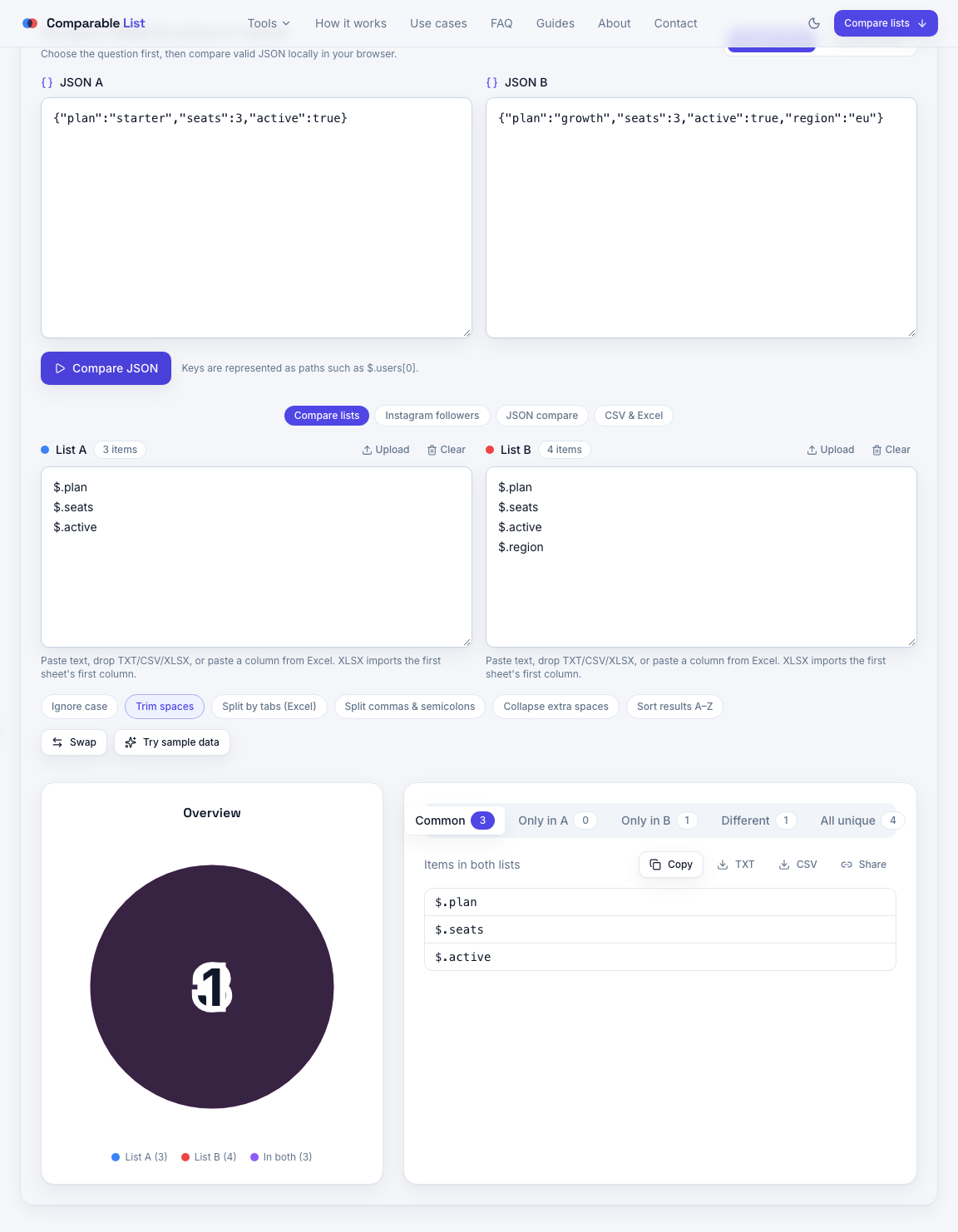
“Compare JSON” can mean two different things. You may want to know whether two responses have the same structure, or whether they contain the same values. Those questions produce different review lists, so a useful comparison starts by choosing the right one rather than pasting two documents into a generic text diff.
1. Decide whether structure or values matter
Choose Compare keys when you are validating a response contract or configuration shape. The tool represents keys as paths, so $.profile.email and $.billing.email remain distinct. Choose Compare values when you need to find primitive strings, numbers, booleans, or null values that occur in one document but not another.
2. Validate before you compare
Copy the raw JSON, not a console object that has been truncated or reformatted with non-JSON comments. The tool requires valid JSON: strings use double quotes, commas separate values, and all brackets close. If a response is sensitive, remove credentials, access tokens, email addresses, and personal data before sharing it with another person.
- Use complete JSON documents from comparable environments.
- Compare the same endpoint or configuration scope.
- Remove secrets before creating a share link or attaching an example to a ticket.
3. Treat differences as a review queue
Common paths show the stable portion of a schema. Only in A and Only in B show paths or values found exclusively on one side. For arrays, paths include an index such as $.users[0]; a reordered array can therefore look structurally similar while its values differ. Use the result to focus investigation, then return to the source documents for the surrounding context.
4. Know when you need a different kind of diff
This workflow compares membership; it does not generate a patch, preserve formatting, or match complete nested records by identity. Use a code-aware diff when you need line changes in a source file. Use a schema validator when you need formal API contract enforcement. For IDs or log lines already one-per-line, the general list tool is faster.
Ready to check your data?
The tool runs locally in your browser. Review the result before you act on it, especially when a list contains customer, account, or operational data.
Open JSON compareRelated workflow
For spreadsheet exports, read the CSV and Excel column comparison guide.